Product Details

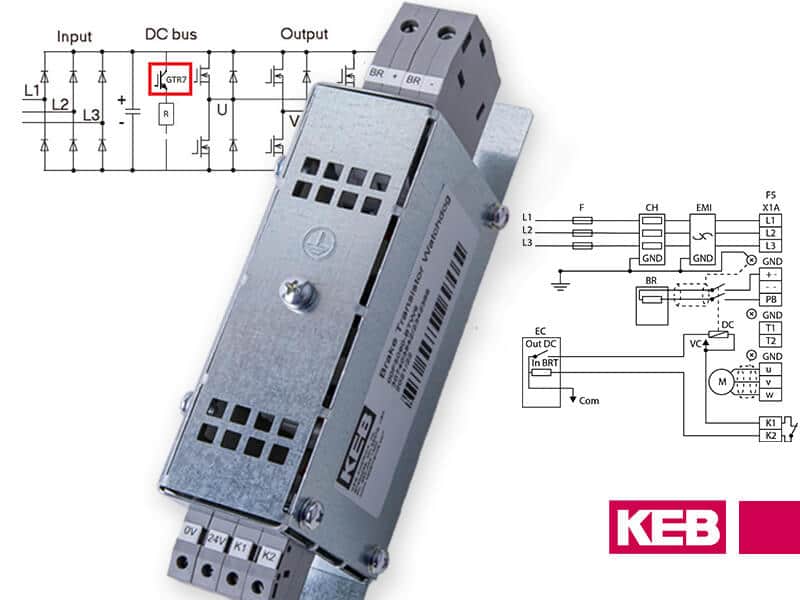
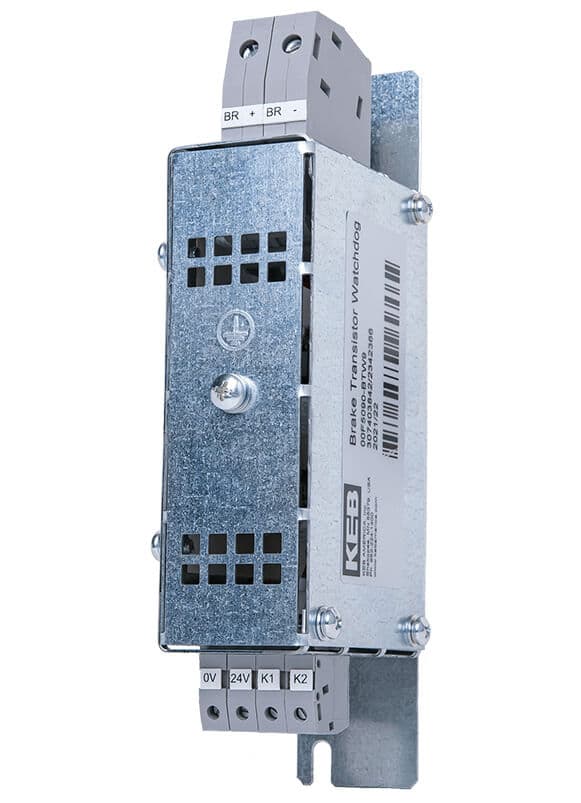
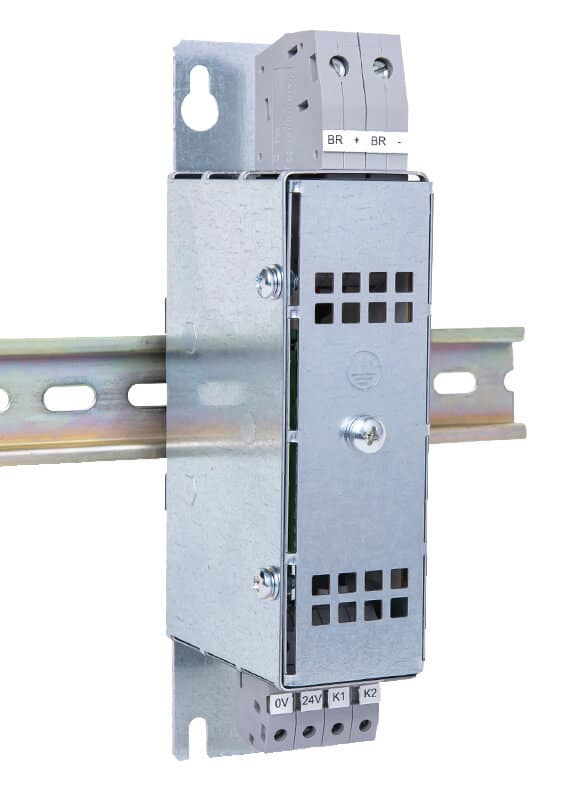
The brake transistor monitor is a simple way to add a layer of protection to the braking circuit in industrial machinery.

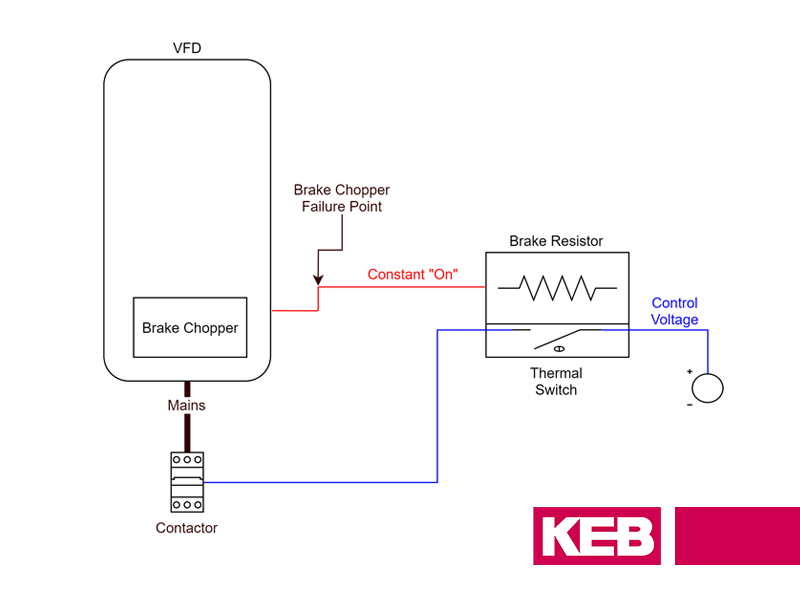
In elevator applications, braking events are frequent, and thermal loading on the resistor can vary. Most braking resistors are sized for intermittent duty, so a failed brake transistor that remains ‘on’ can quickly overheat a resistor. The monitor provides a dedicated safeguard that detects a brake transistor short circuit and reacts before thermal overload becomes a fire risk.

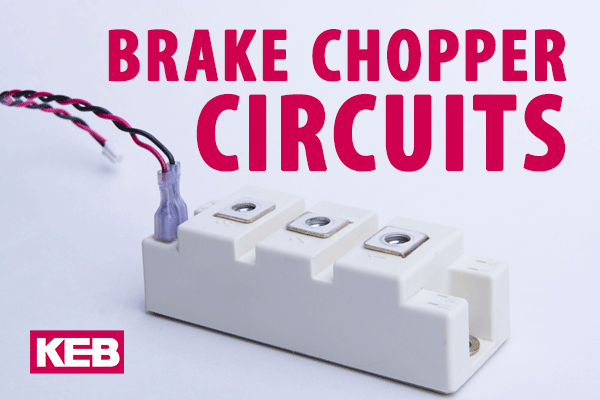
Applications that need enhanced thermal protection for their resistors and braking profiles should evaluate the brake chopper circuit and VFD braking resistor for their specific needs. These components work together to handle regenerative energy by dissipating it.

Tech Specs

Electrical

• Supply Voltage: 24VDC (18 to 30V)
• Supply Current: 10mA @ 24VDC
• Contact Rating (K1/K2): 2A DC Maximum (30VDC), 2A AC Maxiumum (120VAC)

Additional Rated Values

• Brake Transistor Monitor Input Range (BR+ / BR–): 350 to 800VDC (840VDC maximum)
• Trigger Threshold: >64 mSec continuous “on” state before K1/K2 state change
• Protection Class: IP20
• Operating Temperature: -10°C to 45°C (extended 5°C to 40°C recommended)
• Altitude Rating: Up to 2000 m above sea level
• EMC Classification: EN 61800-3, Class C2 emissions

Installation

These specifications define the operating conditions the monitor must meet to function properly and should be followed during component selection and installation. For example, the BR+/BR– input range allows safe integration with a broad selection of KEB braking transistor configurations used in COMBIVERT F5 and F6 systems. The K1/K2 pilot contact provides a simple but effective control point for disconnecting either the brake resistor or the incoming AC line.

Mount the unit according to the manual’s recommended distance clearances using appropriately rated conductors. Parallel connections with the braking resistor require a distribution block. Both the drive and monitor must connect separately to avoid double conductors under a single terminal.

How Our Monitor Works

The KEB Brake Transistor Monitor is used to check the health and status of a VFD’s brake transistor. If the brake transistor fails in a short circuit condition, the monitor will safely disengage the resistor circuit to prevent the resistor from overheating from continuous current flow. Designed as an external, independent monitoring device, it electrically supervises the brake transistor output from compatible KEB drives.

The braking transistor is activated by the VFD when the DC bus reaches a predefined threshold and allows current to flow into the braking resistor. Under normal operating conditions, the braking transistor modulates on and off until the VFD bus voltage falls below the activation threshold. The monitor checks that the brake transistor switches off at least once within a defined time window. If it does not, the monitor interprets the condition as a fault.

Specifically, the unit looks for an “off” state at least once every 64 mSec. If the brake transistor output stays continuously on beyond this threshold, the monitor opens its normally-closed pilot contact (K1/K2).

This action can be used to remove power from the brake resistor through either a DC brake resistor contactor or an AC line contactor. In both cases, the goal is the same: interrupt current flow and prevent the resistor from overheating.

This approach aligns well with elevator drive requirements, where safety and thermal protection are essential.

Our monitor is also applicable to other systems using KEB drives with dynamic braking, including hoists, indexing machines, test stands, and high-inertia loads. The device helps reduce fire hazards and extend the service life of braking components.

Brake Transistor Monitor Applications

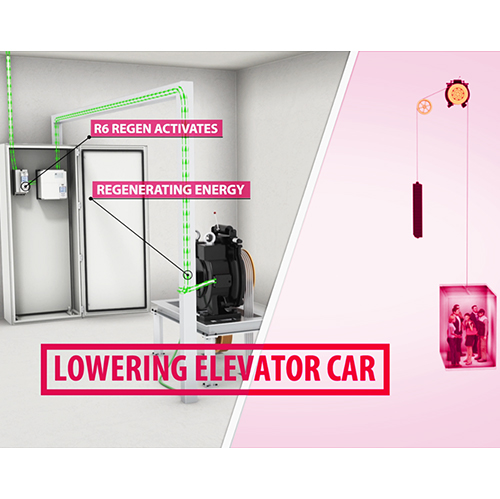
The Brake Transistor Monitor is widely used in elevator control systems built around KEB’s COMBIVERT F5 and F6 drives. Elevators present a demanding environment for braking resistors, and this monitor provides an additional safeguard for both equipment integrity and building safety.

Aside from elevators, the monitor supports many other KEB-driven systems that rely on dynamic braking.

This includes:
Material-handling equipment
Cranes and hoists used in stage and theater
Industrial machinery with rapid stopping events
Test stands with frequent deceleration cycles

The monitor provides a protection mechanism that detects a shorted brake transistor before thermal overload becomes dangerous.

To further enhance braking safety, KEB also manufactures a complete line of industrial brakes and system components that integrate with VFD-based control architectures. These solutions can be tailored to specific duty cycles and heat dissipation requirements.

Why Choose KEB?

KEB’s Brake Transistor Monitor is built specifically for KEB drive systems and follows the same engineering standards as the COMBIVERT F5 and F6 platforms. By monitoring the brake transistor independently of the drive, the unit adds redundancy to a critical safety path.

The device is simple to install, requires minimal wiring, and provides deterministic fault detection without software dependencies.

For OEMs and system integrators, the monitor helps reduce risk while maintaining predictable braking performance. KEB also offers engineering support to help ensure correct resistor sizing, proper wiring practices, and appropriate selection of distribution blocks or contactors.

FAQs


Will this work with my non-KEB VFD?

The Brake Transistor Monitor is designed for use with KEB COMBIVERT F5 and F6 drives. Using it with third-party VFDs falls outside its defined application. However, certain systems may still be suitable depending on the DC bus characteristics and how the braking circuit is configured.

In these cases, KEB can review the electrical details of the installation and advise whether the monitor will operate correctly or if another solution would be better suited.


What’s the maximum DC bus voltage it can monitor?

The monitor is rated for a BR+/BR– input of 350 to 800VDC, with an absolute maximum of 840VDC. These values align with the DC bus characteristics of KEB elevator drives and must not be exceeded. Staying within this range ensures accurate fault detection and helps maintain proper isolation levels in the braking circuit.


How fast will it detect a shorted transistor?

The Brake Transistor Monitor evaluates the brake transistor output and requires the signal to switch off at least once every 64 mSec. If the transistor remains continuously on for longer than this duration, the monitor will trip its normally-closed contact.


Can this work with regenerative drives?

The monitor is intended for systems using dynamic braking with a brake resistor. Regenerative drives route excess energy back to the supply and do not rely on a braking resistor in the same way. For that reason, the monitor does not provide a functional benefit in regenerative configurations.


Can KEB help size this for my application?

Yes. KEB engineers routinely assist with brake resistor sizing, braking energy calculations, and safe integration of the monitor into elevator and industrial control panels.

Contact Us

Let's Work Together

Connect with us today to learn more about our industrial automation solutions and how to commission them for your application.

"*" indicates required fields

This field is for validation purposes and should be left unchanged.

Let's Talk

KEB has helped our customers solve many automation challenges. Let’s discuss your challenges and goals and see how we can help.